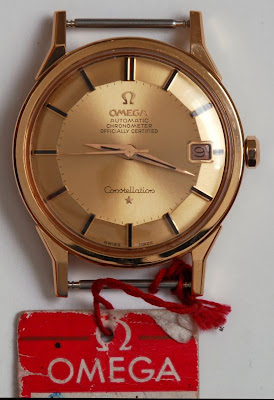

Original NOS Constellation with 18K Dial - Courtesy MikeN (click on pictures for an enlarged view)
How can you be absolutely sure you have a factory original Constellation? This is a question I field regularly from subscribers to this blog. The answer to that question is that you can’t, except on rare occasions. Crowns and crystals on a well-serviced vintage watch will probably have been changed over time. Damaged or degraded dials were routinely replaced during service when genuine replacements were still available; rotors, rotor posts in some models and rotor bridges were swapped when supplies were plentiful, and other worn parts were exchanged for new.
Service bulletins of now vintage Omega watches outlined clear regimes of servicing that included the replacement of sub-standard parts and indeed recommended replacement of some parts at every service irrespective of their condition. Basically the idea was that, after servicing, your Omega would be returned looking as new as was possible. Same thing happens today on contemporary Omega watches.
This tradition of replacing old for new in watch servicing and maintenance serves the owner well as long as the model remains ‘factory supported’, when replacement parts are plentiful and the watch is a contemporary model. However, as a watch edges into vintage status, supplies of some parts become scarce, the factory stops manufacturing replacement parts and, in the case of Omega vintage watches, the factory will replace worn parts with the nearest available fit and will refinish dials it believes are not up to a certain standard. This is why I recommend owners of vintage Constellations do not have their watches serviced by Omega in Bienne or an Omega agent, but source a reputable watchmaker who will preserve as much of the ‘originality’ of the watch as possible.
To return to the original question, it is possible, but not easy, to acquire a factory original Constellation (as the above picture attests). Infrequently a genuine new old stock watch will emerge from a dealer’s safe after his passing; occasionally a solid gold ‘years-of-service’ watch will surface after decades of preservation in some dark cupboard space, and every now and then one comes across a Constellation that has been only worn by the owner on special occasions and retains most, if not all, of its originality. These pieces are very special and difficult to find.
For most collectors of vintage Constellations, factory specification, as opposed to factory original, is a satisfactory compromise at which to arrive. As long as the dial is original to the watch and not refinished, as long as all watch parts and case comply with factory specifications for the model, and the signature parts have not been disturbed (train bridge with serial numbers that match case and calibre) they are happy with their acquisition. Box and papers are an added bonus as the papers confirm serial numbers and provenance.
The factory original, if and when it comes your way, is an event worth celebrating. In the meantime, Constellations that meet factory specifications will continue to appreciate, be highly collectible and satisfy the collector’s thirst for the genuine article.



