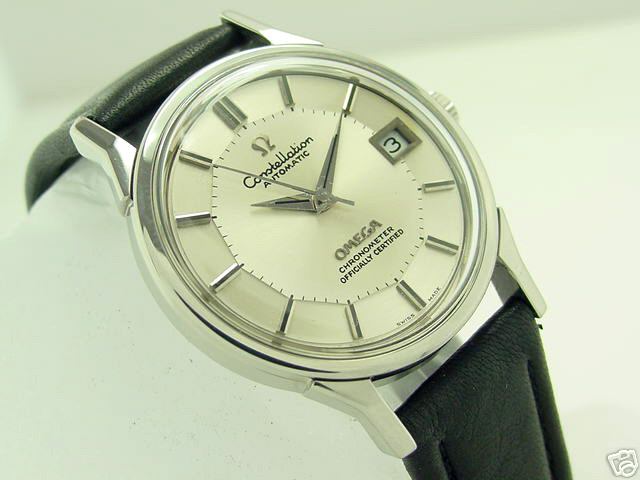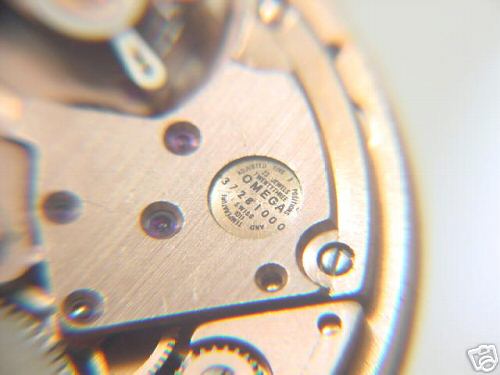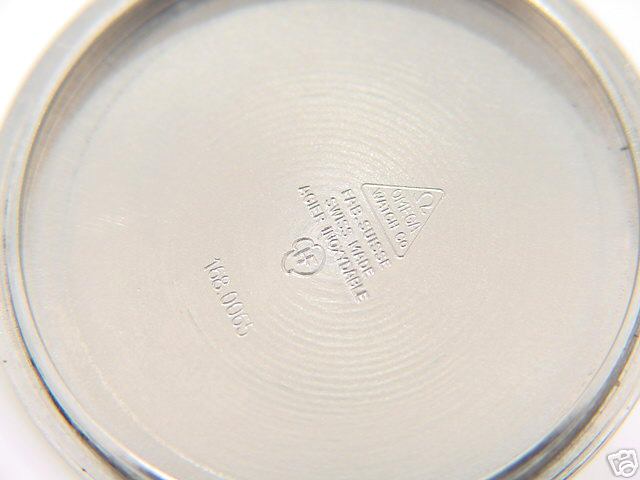
There’s an ongoing debate in museum circles about the ethics of conservation and restoration of what is categorised as Technological Heritage. Watches fit into this category, and while we may scoff at armchair academic pronouncements on how we should go about maintaining our collections, it’s worth more than a thought.
The vintage watch market seems to operate not so much on the ethics of conservation, restoration and preservation of historical integrity, but on the economics of supply and demand as it applies to conserved, restored and indeed refurbished technology. In many cases it’s ‘opinion’ that informs the choice of what to do with a vintage watch and while there are as many opinions as there are people, some opinions carry more weight financially than others.
Perhaps not so strangely, the high end of the market, often represented by prices fetched at Antiquorum, Christies, Sothebys and others, reflects a decided bias towards conservation and restoration over refurbishment. On rarer high-end timepieces originality attracts premium prices, while refurbished high-end watches are much less in demand.
First let’s arrive at a working definition of conservation, restoration and refurbishment so as to at least have a set of benchmarks upon which we may base our restoration decisions.
CONSERVATION
A concept of conservation emerged about a decade and a half ago in respect to vintage technology and is beginning to have an impact on the serious horological markets. It basically argues that emphasis should be placed on preservation of originality for the future and that making vintage technology appear pristine and never used is analogous to vandalism.
The idea behind conservation is that all changes to the object should be reversible. Take dials for example: If one was to take the conservation line when working on a vintage dial, refinishing the dial would be out of the question, but stabilising it with a protective layer of lacquer would, as long as the lacquer could be removed at a later time.
The same logic applies to movements. The conservationist would argue that parts should not be replaced because having the technology operating is far less important than preserving its originality.
Here’s an example that places technological conservation into a broader context. The Australian War Memorial has a collection of WW2 German military aircraft, and when experts conducted their pre conservation condition survey they identified a grey blue oxide coating on the aircrafts’ aluminium. They conditionally identified the type and constituents of the coating and devised a conservation strategy that ensured the original coating was not destroyed.
On similar aircraft in the United States, however, preservation work resulted in the removal of the oxide coating, thus destroying the originality of the technology and giving cause for confusion in scholarly investigation of the future. Many in the field of technological conservation would argue that removing an original coating in order to make the aircraft look new is unethical – same thing for watches and clocks of historical value.
RESTORATION
Restoration is not identical to conservation. Restoration is a process that attempts to return a piece of technology, in our case a timepiece, to a previous state that a given restorer, complete with prejudices, assumptions and opinions about what the object should represent, imagines to be original. Restoration is personal to the restorer and that should never be forgotten.
However, in respect to technology, restoration is controversial, since it often involves irreversible changes to the original material of the technology in order to make it work and function as it was meant to function.
In the case of more valuable mass-produced watches or larger volume haute horlogerie pieces, Restoration is favoured by both the ‘expert’ and the knowledgeable ends of the market. Values are higher for working models that are as near as possible to what came out of the factory. The difference between conservation and restoration as it applies to watches is that a restored watch always works. Restoration work does not necessarily have to meet criteria of reversability.
In drawing a line between restoration and refurbishment, it could be said that restoration is more painstaking. For example, meticulously removing the markers of a watch, dissolving the damaged top lacquer without destroying the paint and lettering on the dial, applying a new coat of lacquer and then re-riveting the markers without the use of glue or solder is quintessentially a restoration function.
Restoration may also involve such things as infilling pitted cases and restoring the original finish, removing gummed-up reverser wheels of an automatic winding system and thoroughly cleaning and re-fitting them, removing hands and cleaning and stabilising them, stabilising dials with patina that has gone deeper that the lacquer top coat, repairing rather than replacing parts, and so on. In a sentence, the basic premise of restoration is to keep the watch as near to ‘factory-original’ as possible. Usually, the expense implicit in restoration dictates that less valuable or collectible watches are better candidates for refurbishment.
However, as some Omegas from the 50s and 60s become rarer through attrition, originality may well have primacy in times to come.
REFURBISHMENT
Refurbishment is often the practice of taking a complete piece, or part, of old technology and making it look brand spanking new again. Refurbishment involves removing an object’s past in the belief the new looking is best or that new looking sells.
We see much evidence of refurbishment wherever we look. Old houses rebuilt to look faux grande with more ornamentation than displayed originally; furniture in the brassier antique shops that appears as smooth and new as the IKEA competitor's product down the street; cars of the 50s and 60s chromed to the hilt and modified to reflect modern concepts of a bygone era, and so on.
Refurbishment of part, as opposed to the whole, of a watch is generally preferred by all ends of the market except the new-old segment. Refurbishment is generally seen as an option when there are no other options. A watch can be partially refurbished by replacing any part of the watch that is damaged or degraded with a genuine new or restored factory specified part: movement parts, hands, dial, crown, case back, case, bezel, crystal, etc. The essence of refurbishment is to keep to factory specifications but not necessarily to pay much attention to maintaining as much factory originality as possible.
In many instances, if a collector sends his vintage watch to, say, Omega in Bienne, it will return having been refurbished. Omega will offer various options as to the extent you want the watch refurbished, and you would be advised to be very explicit in your instructions as to how far you wish to go in the process.
It’s fair to say that moderate refurbishment was, and is, the industry standard. In days gone by, consumers wanted their mechanical watches to perform accurately and look smart. This was reflected in the service bulletins produced by manufacturers who, as a matter of course, would recommend replacing parts, substituting degraded dials, fitting new crowns and crystals and polishing the watch case. But, as models of the 1950s - 70s attain true vintage status, such practices may compromise the aesthetic, historical and monetary value of these watches.
The worst acts of refurbishment occur when watchmakers seek to create a new-old watch specifically for the neophyte or non-collecting segment of the vintage market. Usually an overly refurbished watch goes beyond the original factory brief. We see countless examples of Omegas with all traces of their former lives obliterated by excessive polishing; refinished dials completed with varying degrees of competence and unoriginal dial patterns fresh from the overactive imaginations of dial refinishers; so-called new-old stock beads of rice bracelets (as opposed to originals that have been restored); sharp and shiny crowns replacing otherwise functional and nicely worn ones; the dressing up of some models to look deluxe rather than standard; wrong movements (but, hey, who cares no-one buying a new-old watch will probably look under the bonnet) and numerous other touches that compromise the integrity of the original model.
Further, the new-old market can get quite excited by a watch that has been made up of mainly new old stock parts, as in the Watchco Speedmasters (an example of complete refurbishment?). While meeting factory specifications, these pieces can be said to fail the ‘history’ test, and, hence, be of much less value to serious collectors or Speedmaster aficionados.
SO WHAT IS THE STANDARD FOR WATCHES
Let’s return to the earlier point on opinion and acknowledge that opinions are simply an expression of personal preference. If we are to build up a reasoned argument that favours one opinion over another in respect to the conservation, restoration or refurbishment of mass-produced watches, then we can choose to look at where opinion converges into a body of knowledgeable practice.
First, there is a market for new-old in any stream of collectibles, and, judging by the mountain of literature written about the new-old segment of various markets, it’s usually where intrigued amateurs or freshly minted neophytes land. Refurbished collectibles are generally a sellers market rather than a buyers market, because buyers do not make distinctions other than visual appeal and mythical investment value of vintage collectibles, thus placing themselves at the mercy of sellers – same thing with vintage watches.
In reviewing a large range of books and magazines on horological restoration and analysing academic pronouncements on the conservation of our technological heritage, I believe the following points are worthy of consideration:
- Conservation is the preferred option for important watches and clocks, particularly those that embody technological innovation. Restoration amounts to wanton destruction of heritage.
- The more rare the object, the greater the case for conservation over restoration. Would a 1970s Calibre 700 Omega Constellation ultra thin circular lever movement limited to 12,500 pieces fit this category?
- In the case of mass-produced watches, restoration is favoured by both the ‘expert’ and the knowledgeable ends of the market. Values are higher for working models that meet fully a manufacturers specifications. In some cases, a watch that has retained all of its original factory assembled parts, even though regulated to compensate for wear, will fetch more than a restored watch that has had replacement parts.
- As the vintage watch market has grown both in size and breadth, there is a growing segment that values ‘functional’ restoration – replacement of worn movement parts and conservation that stabilises non-working parts of a watch.
- Refurbishment of part, as opposed to the whole, of a watch is generally preferred by all ends of the market except the new-old segment. Refurbishment is generally seen as an option when there are no other options.
- Refurbishment to create a new-old watch has a market for newbies. The prices paid can be high but re-selling values can be severely discounted.
So where do I stand? Put me in the Functional Restoration group!